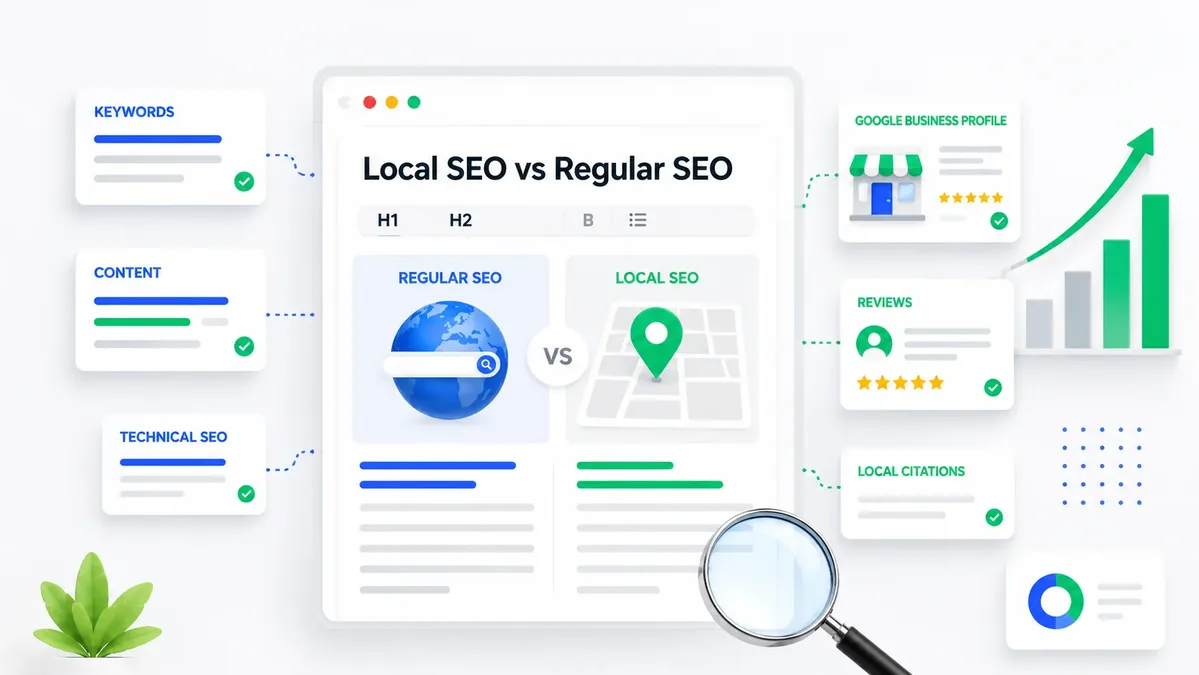
The main difference between local SEO and regular SEO is the audience each strategy is designed to reach. Regular SEO helps a website appear for broad organic searches, while local SEO helps a business appear when people search for products or services within a specific geographic area.
Local SEO uses many of the same strategies as regular SEO, including keyword research, content creation, link building, on-page optimization and technical SEO. However, it also focuses on Google Business Profile optimization, Google Maps rankings, customer reviews, local citations and location-specific keywords.
For example, a regular SEO campaign might target "how to repair a leaking pipe," while a local SEO campaign might target "plumber in Toronto" or "emergency plumber near me."
This article explains how local SEO differs from traditional SEO, where the two strategies overlap and which type of SEO your business needs.
What Is Regular SEO?
Regular SEO is the process of improving a website so that it ranks higher in the organic search results on Google and other search engines.
It is also commonly called traditional SEO or organic SEO.
Regular SEO generally focuses on searches that are not limited to one particular city or neighbourhood. The goal is to increase a website's visibility for relevant topics, products or services, regardless of where the searcher is located.
For example, regular SEO keywords could include:
- How to repair a leaking faucet
- Best accounting software for small businesses
- Organic dog food
- How permanent outdoor lighting works
- Women's clothing online
The main components of regular SEO include:
- Keyword research
- High-quality content
- On-page SEO
- Technical SEO
- Internal linking
- Website speed
- Mobile usability
- Link building
- Website authority
Regular SEO is especially important for e-commerce stores, software companies, online publications and businesses that can serve customers nationally or internationally.
However, local businesses also need regular SEO. A strong website gives Google more information about a business's services, expertise and relevance, which can support both organic rankings and local search visibility.
What Is Local SEO?
Local SEO is the process of improving a business's visibility for searches connected to a specific location.
It helps businesses appear when someone searches for a nearby product, service or company. These searches may include an obvious geographic keyword, such as:
- SEO company in Toronto
- Dentist in Etobicoke
- Plumber in North York
- Window cleaning in Mississauga
Other searches may have local intent without including the name of a city:
- Dentist near me
- Emergency plumber
- Coffee shop
- Car repair
- Roofing company
Google understands that people making these searches are usually looking for a nearby business. It therefore uses the searcher's location, the business's location or service area and other local ranking factors to determine which companies to display.
Local SEO is particularly important for:
- Home-service companies
- Contractors
- Restaurants
- Retail stores
- Medical clinics
- Dentists
- Lawyers
- Photographers
- Local agencies
- Service-area businesses
- Businesses with multiple locations
Unlike regular SEO, local SEO is not focused exclusively on the website. A business's Google Business Profile, customer reviews, local directory listings and geographic relevance can all influence its local visibility.
What Is the Main Difference Between Local SEO and Regular SEO?
The main difference is that regular SEO targets broader organic visibility, while local SEO targets people searching within a particular geographic market.
Both approaches aim to improve search engine visibility, but they use different keywords, ranking factors and search-result features.
Target Audience
Regular SEO can target people across a province, country or the entire world.
A company selling accounting software online, for example, may want to reach business owners throughout Canada. The searcher's physical location may not matter because the product can be purchased and used anywhere.
Local SEO targets people in a defined city, neighbourhood, region or service area.
A Toronto roofing contractor does not need to reach every homeowner in Canada. It needs to appear when homeowners within its service area search for roof repairs, roof replacements or emergency roofing services.
This narrower geographic focus can produce fewer website visitors than a broad national keyword. However, those visitors are often more relevant because they are located within the area the business actually serves.
Search Results
Regular SEO primarily focuses on traditional organic search results.
These are the website listings that appear on a Google search results page, usually with a title, URL and description.
Local SEO can target two separate areas of the search results:
The Google Map Pack
The Map Pack — sometimes called the local pack or local 3-pack — usually displays several nearby businesses alongside a map. Listings can include reviews, hours, addresses, phone numbers, photos and directions.
A business's Google Business Profile is one of the most important assets for appearing in these results.
Localized Organic Results
These are the traditional website results that appear beneath or around the Map Pack. Google may adjust these listings based on the searcher's location, even when the search does not contain a city name.
A complete local SEO strategy works on both Google Maps visibility and localized organic rankings.
Ranking Factors
Regular SEO and local SEO share several ranking factors.
Both benefit from:
- Helpful and relevant content
- Proper keyword targeting
- Strong page titles and meta descriptions
- Fast website performance
- Mobile-friendly design
- Internal linking
- Technical SEO
- Quality backlinks
- A clear website structure
Local SEO adds several location-specific signals, including:
- Google Business Profile optimization
- Proximity to the searcher
- Customer reviews
- Local citations
- Consistent business information
- Service-area and location pages
- Locally relevant backlinks
- Geographic keyword targeting
- Local relevance and prominence
For local SEO, Google needs to understand what the business offers, where it operates and whether it appears to be a trusted and established option in that area.
Local SEO vs. Regular SEO: A Quick Comparison
| Category | Regular SEO | Local SEO |
|---|---|---|
| Primary audience | Regional, national or global | A specific city or service area |
| Search intent | Broad research or online purchasing | Finding a nearby business or service |
| Keyword example | "How to fix a leaking faucet" | "Plumber in Toronto" |
| Main search results | Organic website listings | Map Pack and localized organic results |
| Main digital asset | Website | Website and Google Business Profile |
| Important signals | Content, backlinks and technical SEO | Proximity, reviews, citations and local relevance |
| Typical competition | Websites across a larger market | Businesses serving the same local area |
| Common conversions | Online sales, sign-ups and website leads | Calls, bookings, directions and quote requests |
Regular SEO can attract more overall traffic because it targets a wider audience. Local SEO usually targets a smaller group of people, but those users may be more likely to contact the business because they are actively searching for a nearby provider.
Does Local SEO Include Regular SEO?
Local SEO includes many of the same foundations as regular SEO.
A business cannot rely entirely on its Google Business Profile while ignoring its website. Google still needs clear, useful and trustworthy website content to understand the company's services and relevance — which is why your website might not be ranking yet.
For example, a local plumber may need:
- A fast and mobile-friendly website
- Individual pages for plumbing services
- Proper title tags and headings
- Helpful answers to customer questions
- Internal links between related services
- Local service-area pages
- Relevant backlinks
- Clear contact information
- Appropriate structured data
The business may then add local SEO strategies such as:
- Optimizing its Google Business Profile
- Collecting and responding to reviews
- Building accurate local citations
- Adding service areas
- Uploading real business photos
- Creating locally relevant content
- Earning links from local organizations
Local SEO is therefore better understood as an extension of traditional SEO rather than a completely separate marketing strategy.
Regular SEO creates the website foundation. Local SEO adds the geographic signals needed to connect that website and business with nearby customers.
Which Type of SEO Does Your Business Need?
Your business model determines whether you should focus on regular SEO, local SEO or a combination of both.
Your business may need local SEO when:
- Customers visit your physical location
- Your employees travel to customers
- You serve a defined city or region
- Your business depends on phone calls or local quote requests
- People commonly search for your service using "near me"
- You want to appear in Google Maps
Examples include contractors, restaurants, dentists, law firms, photographers, cleaning companies and other local service businesses.
Your business may place greater emphasis on regular or national SEO when:
- You sell products across the country
- Your service is delivered entirely online
- Your customers can be located anywhere
- You operate an e-commerce store
- You publish information for a broad audience
- Your main keywords do not have local intent
A software company serving customers throughout North America, for example, would normally prioritize regular SEO. A Toronto HVAC company would need local SEO because its technicians can only serve customers within a defined area.
Can You Use Local SEO and Regular SEO Together?
Most local businesses should use both local SEO and regular SEO together.
Local SEO can help the business appear for searches with immediate geographic intent, such as "SEO company near me" or "Toronto SEO agency."
Regular SEO can help the same business reach people earlier in the research process through searches such as:
- How much does SEO cost?
- How long does SEO take?
- What is technical SEO?
- How do backlinks affect rankings?
- What is the difference between local SEO and regular SEO?
Publishing informational blog posts is one of the most reliable ways to build this kind of organic visibility. The informational content attracts potential customers, builds topical authority and strengthens the overall website. Local service pages and Google Business Profile optimization then help convert nearby searchers into calls and leads. Read our guide: how to write blog posts that actually rank on Google.
A business with several locations may also use a hybrid strategy by combining:
- A strong national or regional website
- Separate pages for each location
- An individual Google Business Profile for each eligible location
- Local reviews and citations
- Broad informational content
- Location-specific service content
The two strategies should support one another rather than compete for attention.
Build the Right SEO Strategy for Your Business
Both local SEO and regular SEO share the same foundation — keyword research, quality content, on-page optimization, technical SEO and link building. The difference comes down to geography.
Local SEO focuses on reaching customers within a specific area — think a car repair shop in Etobicoke that wants to show up when someone nearby searches "mechanic near me." Regular SEO takes a broader approach — think of a car parts retailer that ships across Canada and wants to rank for searches with no geographic boundary. Most small businesses that serve customers in a specific city or region need local SEO. Some need both.
Junction SEO helps small businesses improve their website rankings, Google Maps visibility and local search presence throughout Toronto and the GTA. Contact us to learn which SEO strategy is right for your business.
Get My Free Website Audit →FAQ About Local SEO
Yes. Local SEO uses the same basic principles as regular SEO, including content creation, keyword research, on-page optimization, technical SEO and link building.
It then adds local ranking factors such as Google Business Profile optimization, customer reviews, proximity, citations and location-specific content.
Businesses that serve customers within a specific geographic area generally benefit from local SEO.
This includes businesses with storefronts as well as service-area businesses that visit customers at their homes or workplaces.
A company does not necessarily need a public storefront to benefit from local search visibility.
A website can rank in localized organic search results without a Google Business Profile. However, an eligible business will usually need a properly optimized Google Business Profile to compete effectively in Google Maps and the local Map Pack.
The website and business profile serve different but connected purposes. The website explains the business's services and expertise, while the Google Business Profile helps establish its location, service area, reviews and local presence.
No. Local SEO targets customers within a defined geographic area. National SEO targets a broader audience across an entire country.
National SEO is generally a type of regular or organic SEO, but regular SEO does not always need to be national. An organic SEO campaign can still target a city, province, region or specialized audience.
Neither strategy is automatically better.
Local SEO is more appropriate for businesses that depend on nearby customers. Regular SEO is more appropriate for companies that can sell products or provide services regardless of location.
For many local companies, the best strategy is to build a strong regular SEO foundation and then add local SEO to improve visibility in Google Maps and location-based search results.